So I have been quiet for a bit, but I return with new experience and insight. Ottoman Turkey was a major trading partner and military opponent to Poland, Hungary, Italy, and France during the sixteenth century. Without their presence the political climate of the time could have been very different. So get ready to fall down the rabbit hole into some research on the clothing of Ottoman Turkish women.
Mistress Sabiha,OP, come to our tiny town to teach a class on 16th century Turkish clothing. Her wealth of information made my head spin as she walked us through patterning the layers, selecting fabrics, and general information on Turkish women. After this class I sought to make an outfit so I could better understand the construction and assist some of our local group make their own.
For those of you who are new to Turkish clothing let me talk you through the layers we discussed.
1. Golmek- This is your underwear/ against the skin layer. Upper class women would have large open sleeves and gold embroidery along the seams. The slit from the neck could go quite low and expose some cleavage. Usually white, but I have seen suggestions of other colors (black).
2. Salvar- Your Pants! Men and women both wore pants in Turkey. The crotches were often pieced on extant garments. Held in place by a drawstring.
3.Midtan- These are short vests which we know were worn in later centuries by Turkish women, and in the 16th century by children at least. For more information please see Mistress Sabhia's blog below.
4. Yelek- This is one of my favorite garments. A long vest which can act as a supportive garment if fitted correctly. They are closed with buttons.
5. Entari- These are lightly fitted, long coats and what women would have worn regularly.
6. Caftan- A large ceremonial/ out-door coat.
We did briefly mention other accessories such as sashes, wooden sandals, fans, small veils, and the flower pot hat. With a little time and research interested parties could find out more on these subjects or you could e-mail the go-to-girl herself.
Other Good pages for more information on Turkish Clothing...
Mistress Sabhia's blog
Ottoman Empire Clothiers on Facebook
Ottoman Women's Clothing late 15th through 16th century
Gallery of Extent Turkish Garments
An overview of Turksih Women's Clothing
Mistress Sabiha,OP, come to our tiny town to teach a class on 16th century Turkish clothing. Her wealth of information made my head spin as she walked us through patterning the layers, selecting fabrics, and general information on Turkish women. After this class I sought to make an outfit so I could better understand the construction and assist some of our local group make their own.
 |
| Women of the Palace, 16th century |
1. Golmek- This is your underwear/ against the skin layer. Upper class women would have large open sleeves and gold embroidery along the seams. The slit from the neck could go quite low and expose some cleavage. Usually white, but I have seen suggestions of other colors (black).
2. Salvar- Your Pants! Men and women both wore pants in Turkey. The crotches were often pieced on extant garments. Held in place by a drawstring.
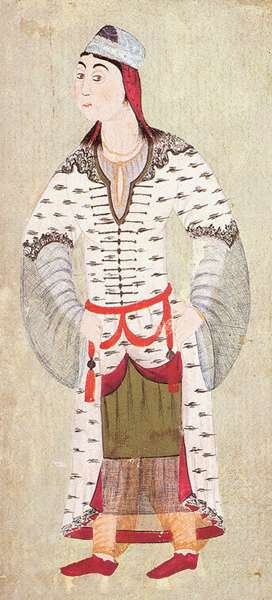 |
| Szigetvári Csöbör Balázs drew several Turksih Miniatures that are dated to 1570 during the Turkish occupation of central Hungary. This Figure is a bit unique, but does show most of the possible layers a lady would wear. |
4. Yelek- This is one of my favorite garments. A long vest which can act as a supportive garment if fitted correctly. They are closed with buttons.
5. Entari- These are lightly fitted, long coats and what women would have worn regularly.
6. Caftan- A large ceremonial/ out-door coat.
 |
| My Entiri is made from a wool blend. (In progress image) Here you see that I chose to incorporate the button loops into a decorative element. |
We did briefly mention other accessories such as sashes, wooden sandals, fans, small veils, and the flower pot hat. With a little time and research interested parties could find out more on these subjects or you could e-mail the go-to-girl herself.
Other Good pages for more information on Turkish Clothing...
Mistress Sabhia's blog
Ottoman Empire Clothiers on Facebook
Ottoman Women's Clothing late 15th through 16th century
Gallery of Extent Turkish Garments
An overview of Turksih Women's Clothing
Comments
Post a Comment